David Potgieter · Project portfolio
Agentic AI systems built around real business work.
A portfolio of AI operating architecture, reusable capability, agent systems, business automation and technical implementation personally architected, directed or implemented by David Potgieter.
The emphasis is not on isolated demos. It is on systems that preserve context, connect to real operations, create reusable capability and produce measurable evidence.

Flagship system
FolderDesk OS
A layered AI Business Operating System designed so humans and AI agents can work from the same business state without collapsing roles, methods, live systems and execution into one brittle control plane.
- Human + AI collaboration and Mission Control layer.
- Twenty-based structured business substrate for CRM, GTM, recruitment, meetings, identity and provenance.
- FolderDesk Agents for persistent organisational roles, context, authority, memory and reusable Skills.
- Execution through FD0, AI Engine, MCP, APIs, deterministic automation, Mac, VPS, Windows and local-model runtimes.
- GitHub and declared business systems retain durable truth and evidence.
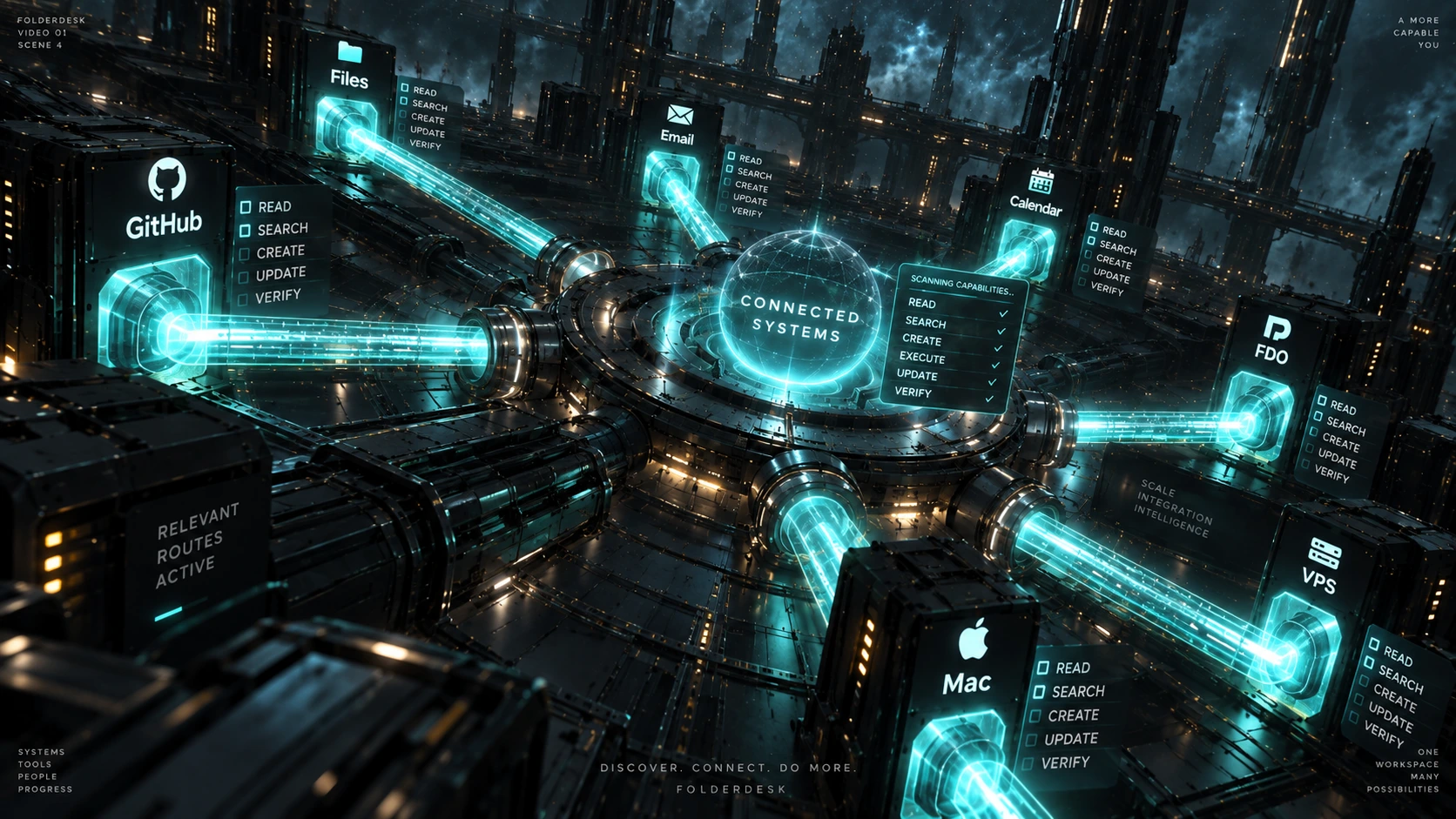
Core agentic systems portfolio
Reusable capability, persistent roles and controlled execution.
124+ personally authored reusable AI Skills
Designed a reusable capability layer that turns successful ways of working into discoverable, versioned methods instead of leaving them trapped inside individual prompts or conversations.
Current operating scale124+ personally authored Skills inside a current organisation-wide catalogue of 137 canonical Skills.
Position-led AI organisation
Created persistent organisational AI roles where identity is based on responsibility rather than a model or bot persona. Each role carries mission, reporting line, authority, canonical owner, Skills and continuity rules.
Current operating scale13 active role profiles across executive, revenue, finance, marketing, communications, recruitment and assessment functions.
Organisation-wide capability discovery
Designed an agent-facing discovery approach that lets a controller locate and load the smallest relevant reusable Skill for a bounded task instead of flooding every session with the entire capability library.
Current catalogueDeterministic discovery operates across 137 canonical Skills while durable methods remain owned in one editable GitHub canon.
Bounded multi-node execution architecture
Built operational MCP patterns that expose authorised capabilities to AI while preserving the real owner of VPS, Mac, Windows, provider and business-system state.
Independent technical evidenceMCP-focused engineering assessment recorded 78/100, with Staff-strength architecture and systems-integration evidence.
Persistent agent-to-agent coordination
Integrated agent identities, messaging, threads, acknowledgements and reservation concepts through Agent Mail while retaining GitHub and the correct domain owner as durable organisational truth.
Architecture principleCoordination transport is separated from business-state ownership so agent collaboration does not become another shadow system of record.
Local inference and continual-learning capability
Designed and operated local AI paths using MLX / oMLX, model benchmarking, hardware-aware routing and first-party continual-learning experiments using trusted internal corpora and held-out regression.
Design goalKeep private, low-latency and specialist inference available as part of a hybrid local/cloud AI operating model.
Production-style AI delivery
OpenAI Agent & Skill Delivery Architecture
A custom-Skill delivery system designed around persistent agents, deterministic order state, hosted execution, independent review and safe recovery.
Agents + environments
Persistent OpenAI Agents, persistent execution environment, hosted command execution and reusable builder Skills.
Deterministic state
Atomic work claiming, explicit workflow state, validation, replay protection, unknown-outcome reconciliation and controlled fallback.
36 passing tests
Current documented regression suite contains 36 automated tests, alongside provider-tested execution and independent model review.
OpenAI Partner Network technical evidenceThe architecture formed part of the technical evidence package covering OpenAI Agents, Skills API publication, hosted execution, governance and production-oriented agent design.
Business transformation portfolio
AI applied to real operations.
21-stage AI-assisted Recruitment Operating System
Converted recruitment from vacancy activation through post-placement follow-up into a durable AI-assisted operating lifecycle covering role design, sourcing, screening, assessment, interviewing, shortlisting, profiles, evaluations, client submissions and placement.
Measured / documented proofOne sourcing batch increased from about 80 to 119 active candidates (~49%). The operating model releases workload capacity equivalent to two recruiter roles, approximately AED 600,000–1.08 million annualised payroll-equivalent capacity at the documented salary range.
Website, brand, copy and SEO production brought in-house
Used AI-supported strategy, copy, identity, imagery, implementation, SEO/GEO and QA to build and continuously operate the iMPLEMENTAi digital estate internally.
Published evidenceDubai market-equivalent external scope was benchmarked at AED 21,000–103,000. FolderDesk continuity evidence includes a 202-commit branch snapshot, a 68-page audit and 15 viewport QA combinations.
Durable operating workflow
Designed a FolderDesk operating pattern that converts a short founder direction into structured, routed and durable execution while keeping the method available for future work.
Documented exampleApproximately 7 minutes of founder input produced roughly 3 hours of structured manual-equivalent execution — an illustrative ~25:1 attention-leverage ratio for that workflow.
Agent workflow optimisation
Optimised a measured agent-routing/status workflow by reducing unnecessary tool use and tightening the execution path.
Measured result92 seconds → 18 seconds; 20 tool calls → 5; 80.4% lower turnaround; 75% fewer calls; 5.1× relative speed for that task class.
Enterprise intelligence
AI Estimation Brain architecture
Designed an enterprise real-estate intelligence architecture for turning historical departmental documents and accumulated operating knowledge into source-linked, auditable AI intelligence.
Knowledge extraction
Structure useful historical information instead of relying on repeated manual document review.
Source-linked answers
Preserve traceability back to source evidence rather than presenting unsupported model output as organisational truth.
Human decision authority
AI supports estimation and retrieval while consequential professional judgement remains explicitly human-owned.
Portfolio classification: enterprise solution architecture / engagement design. This is not presented as a fully deployed client production system unless the underlying engagement evidence establishes deployment.
Technical foundations
Systems thinking predates the current AI stack.
Integrated security & infrastructure systems
Designed and delivered CCTV, IP cameras, access control, networks, servers, UPS, intercoms, electric fencing, gate automation and satellite systems through Think Secure.
Enterprise operations
Built practical experience with corporate process, contractor coordination, Oracle-based systems, service governance and operational accountability inside Emirates Group.
Human assessment & recruitment systems
10,000+ personal interviews and 1,000+ personal placements created a deep foundation in requirements discovery, structured questioning, evidence extraction and decision-making.
Technical positioning
Low-code Agentic AI engineering, not conventional software engineering.
David's strongest contribution is architecture, systems design, code reading, AI-assisted implementation, technical review, integration, testing, debugging and orchestration.
Models & agents
OpenAI, ChatGPT, Codex, Claude, Claude Code, multi-model routing, agents, Skills, MCP and local LLMs.
Infrastructure & data
Linux, macOS, Windows, VPS, Docker, PostgreSQL, Redis, OAuth, Cloudflare, FastAPI environments and distributed execution.
Working code familiarity
Python, TypeScript / JavaScript, SQL, Bash and PowerShell, used primarily through AI-assisted development, review, integration and debugging.
Want to apply this operating approach to a real business problem?
David works across AI transformation, agentic architecture, implementation leadership, fractional AI leadership and project-based systems work.